01
First flights and naval aviation
As a child, Marc Ranjon sees Marcel Doret at an air display in Chauvigny. At fourteen, he takes his first flight in a Stampe SV-4 at Le Blanc. He then learns to fly gliders and powered aircraft, paying for flying hours by teaching mathematics.
From 1959 to 1964, he serves as a pilot in French naval aviation. He trains at Fréjus-Saint-Raphaël, at Cognac on the T-6 and at Ajaccio on the Beech 18. He flies SO-30P missions in Algeria, Tunisia and France, before joining maritime patrol operations on the Lockheed P2V7 Neptune at Lann-Bihoué.
In their account, Marc and Geneviève describe him as the first gliding instructor in Corsica, training his class and three civilians. He also sails, winning the Corsican championships in his Vaurien dinghy. After the Algerian conflict, budget restrictions limit his flying to around 80 hours a year. Despite encouragement from the Navy to remain, he returns to civilian life.
02
Le Blanc and meeting Geneviève
Back in Le Blanc, Marc works in the family insurance and property business. He helps revive the flying club, which has been closed for ten years, and becomes its volunteer chief instructor for powered flight and gliding. The document places the club fortieth in France four years later.
He meets Geneviève, daughter of Colonel Mondran, who commands the air force depot beside the airfield. Their marriage begins a shared adventure in business and in life. Geneviève later recounts its beginnings and difficulties in Envolée à deux, available in English as Soaring Together.
03
From importing gliders to founding Centrair
The couple starts by importing a Schleicher Ka 6, used for aerobatic displays at regional air shows. French certification takes two years, at a time when national standards differ. Their account describes it as the first German glider certified for import into France. The ASK-13, ASK-14, ASW-15, ASK-16, ASW-18, ASW-19, ASW-20 and ASK-21 follow.
The business begins as a sole proprietorship in 1967 and becomes Centrair, a limited company, in January 1970. Initially, four employees work in 400 m² of rented premises at Le Blanc airfield. Marc and Geneviève lead the company, while Marc also carries out aircraft testing, acceptance flights and deliveries.
Between 1973 and 1976, Centrair employs around twenty people and records turnover of approximately seven million francs. A 6,000 m² factory supports Cessna distribution and exclusive representation of Grumman, Bellanca, Caproni and IAR. The company operates radio, maintenance and mechanical workshops equipped for machining, bending and argon welding.
Reims Aviation, then associated with Cessna, acquires a stake through its director Pierre Clostermann, with whom Marc develops a close relationship. The document reports sales of almost one hundred Cessnas and more than one hundred aircraft from the other represented manufacturers. Centrair also continues importing Schleicher gliders.
04
The ASW 20 F and its winglets
The rising value of the German mark and long delivery times lead Centrair to begin licensed production of the ASW 20 F in 1977. The first aircraft is completed in July 1978 and certified in November. More than 140 are built, over half for export.
With ONERA and the Toulouse aeronautical test centre, Centrair develops vertical wingtip surfaces, then called “pennes”. Aircraft fitted with them are designated ASW 20 FP. The account highlights improved turning behaviour, reduced induced drag and their competition results in 1981.
In the document, Marc claims a world first for the certification of these winglets. He recalls initial criticism, followed by their wider adoption by manufacturers and on airliners. The licensing relationship with Schleicher ends in the early 1980s as Centrair prepares its own designs.
05
The Pégase and Marianne
Centrair’s design office develops the C-101 Pégase, a Standard Class single-seater, with ONERA. Its evolving OAP 01/OAP 02 airfoil removes the need for conventional wing washout. The prototype flies in November 1981 and is certified in June 1982. Marc personally takes part in testing, including spin recovery with 60 litres of water ballast in one wing and none in the other.
Six pre-production aircraft are delivered in 1982. By the end of 1983, 105 Pégase gliders have been delivered and production is approaching ten per month. Almost 700 are eventually built at Le Blanc.
The C-201 Marianne two-seater answers a call for tenders from public authorities and the French gliding federation. It receives state support and draws on work with Avions Marcel Dassault, CATIA software, ENSICA, ONERA and SUPAERO. The document mentions around 130 aircraft, followed by the programme’s closure after Centrair changes ownership and its replacement by the foreign-licensed Alliance 34, of which fewer than 43 are built.
06
A factory and expertise in composites
In a town of around 7,000 inhabitants, Centrair brings together engineers, model makers, production teams and quality-control staff. Half of its 6,000 m² factory is climate-controlled. A machine with 84 glass or carbon-fibre bobbins impregnates and compacts fibres to produce spar caps. Laser cutting equipment and an autoclave complete the industrial facilities.
Two IBM 34 computers support production planning and quality control. Centrair receives the French productique prize in 1984, followed by the “Innover pour exporter” prize in 1985. Marc and Geneviève emphasise the reliability of the aircraft and describe the company as the world’s second-largest glider manufacturer in the 1980s. Staffing reaches 82 at the end of 1983 and almost 100 at the end of 1985.
Applications extend beyond gliders: a full-scale model for Citroën, a Renault Formula 1 nose designed to absorb a 60 km/h impact, Exocet missile components, helicopter parts, Airbus floors and cockpit-access door, early Matra drone airframes and a ventral pod for the Reims F-406.
07
Deltaplane, Moto Delta and Parafan
At the 1973 Paris Air Show, Marc meets journalist Christian Paul Depasse, who is presenting a hang glider imported from the United States. Centrair manufactures the first 500 metal frames for the aircraft marketed as Deltaplane, then composite cabins for around twenty powered Moto Delta aircraft designed by Jim Geiser.
Before the company changes hands, Marc spends more than six months developing the Parafan powered parachute, first as a single-seater and then as a two-seater. Around fifty are built. The account describes successful exports before the programme is abandoned.
08
Unfinished projects
Marc acquires a Liné gantry milling machine in Nantes that had been used to manufacture Concorde spars. With six heads and reported dimensions of 8 by 3.2 by 2 metres, it is intended to machine large forms, up to the size of a coach. A building and foundation are constructed, but insolvency arrives before commissioning. According to his account, the machine is later destroyed.
The Supair is a proposed single-engine piston aircraft with a pusher propeller and V-tail. Marc recalls receiving a card from Marcel Dassault saying: “What you are doing is good. Keep going.” He had never met the industrialist or spoken with him by telephone. Dassault studies the aircraft’s shape, while a Toulouse design office works with support from SUPAERO, ENSICA, Professor Laroze and the CEAT. Wind-tunnel tests are carried out and tooling is prepared for the wings, fuselage and landing gear.
The initially selected 240 hp Porsche engine is discontinued by its manufacturer after around one hundred examples. Marc considers a 300 hp Lycoming or Continental, but the takeover of Centrair interrupts the project. He states that the moulds and associated equipment, transferred to Robin Aviation, are later destroyed.
The document gives calculated Supair performance figures: a 103 km/h stall speed, 380 km/h cruise at 8,500 ft and 75% power, a sea-level climb rate of 7 m/s and a theoretical ceiling of 22,000 ft. These are calculation and wind-tunnel projections; the document reports no flight validation. Marc compares them with 333 km/h at 8,000 ft for a 310 hp Cirrus.
09
Leaving Centrair and rebuilding their lives
Marc and Geneviève devote part of their testimony to the 1986 crisis and the loss of their company. They describe an approach concerning financial investment, followed by several administrative inspections. In particular, they dispute the consequences of a delay between invoicing, acceptance and payment for seven Marianne gliders intended for the French air force, and the repayment conditions for training support.
Their account describes a meeting at the prefecture, insolvency proceedings and the takeover by the Chauffour brothers under the name SN Centrair, managed by Mr Megrelis. Marc says that he was dismissed five months later without the agreed compensation following an accusation of stealing plans. He states that an investigation subsequently cleared him and that the promised sums were paid two years later. This is the Ranjons’ account; the document does not include the administrative or judicial records.
They describe a very difficult period, including two years of depression for Marc. Geneviève finds work as human resources director at Futuroscope. The couple later settles at Villa Emma in Poitiers, renovating it over fifteen years and rebuilding their finances by buying, restoring and selling property.
The document also discusses the acquiring group’s purchases of Kirié, Kelt, a Toulon shipyard, and later Robin, Reims Aviation and Mudry. Marc offers a critical view of this period and the decline of the French general aviation industry. The complete PDF preserves his detailed account and assessments of these events.
10
Aviation expertise and international assignments
With Geneviève’s support, Marc develops a consulting and expert-assessment practice for insurers and courts through Airexpert and later ExpertAero. He also represents Mooney in France. His sales memories include a Mooney purchased by Michel Sardou, which leads to a television appearance.
He reports a two-month assignment in Dakar, financed through a World Bank loan, to prepare the establishment of a Senegalese aviation investigation bureau: procedures, recruitment, training and required resources. He also advises banks and Bpifrance on the viability of new-product projects.
The aviation press reports more than 11,000 flying hours in 2018 on over 200 different aircraft. The updated family document gives a total exceeding 12,000 hours and more than 2,200 expert assessments, with his practice continuing in 2026.
11
Books drawn from a lifetime of flying
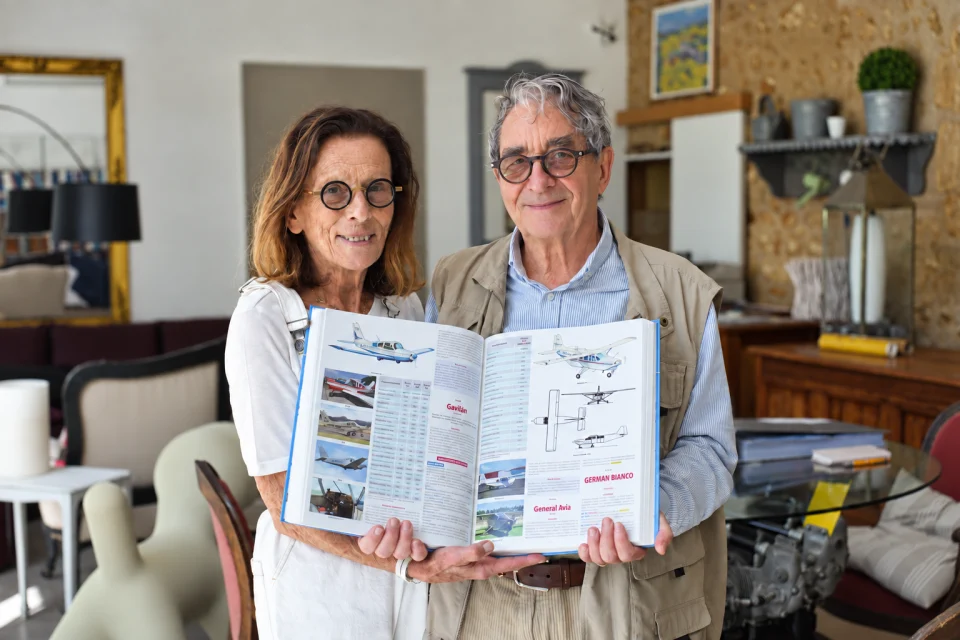
Marc brings together manufacturers’ histories, variants, specifications and flying qualities. Photographs, three-view drawings, cutaways and performance tables accompany advice on operation and purchase. His experience as a pilot and expert informs his commentary.
1998: Encyclopédie des monomoteurs, 783 black-and-white pages, now unavailable. 2009: Encyclopédie Piper, around 170 colour pages, from the J-3 Cub to aircraft current at publication.
2017: Encyclopédie Cessna, around 315 illustrated pages, from the earliest models to the Citation jets. 2020: Encyclopédie Beechcraft, around 130 pages, from the Staggerwing to Hawker aircraft.
2024: Encyclopédie Hélicoptères, covering civil and military helicopters produced in more than ten examples by 42 manufacturers. The account mentions around 178 pages; the product page specifies the pagination of the edition on sale.
2025: Encyclopédie Aviation Générale, more than 700 pages, approximately 5 kg, over 1,500 illustrations and 270 manufacturers. This volume complements the Piper, Cessna and Beechcraft books. It appears in the 2026 selection for the Aéro-Club de France literary prize. Selection does not mean that the prize has been awarded.
Envolée à deux, published in 2018 by Geneviève Mondran-Ranjon, recounts their personal and professional journey. The document associates that year with recognition from La Renaissance Française. The book is offered on this website in French and in its English translation, Soaring Together.
12
Coverage in the aviation press
The document cites a two-page Air et Cosmos article in 1996 on Centrair’s composite expertise and the Supair project. It recalls aeroVFR reviews of the Cessna, Beechcraft, helicopter and general aviation volumes, along with Aerobuzz coverage of the Cessna book in 2018 and its author in 2025.
In 2018, Jacques Callies devotes an Aviation et Pilote editorial to him, “Marc Ranjon, l’homme discret”. A profile titled “Marc Ranjon, l’encyclopédiste volant” also appears in the contents of the January 2025 issue of Info-Pilote.
13
Qualifications and honours listed in the document
The account lists service as a naval aviator, test pilot, instructor and examiner for powered aircraft, gliders and microlights, as well as veteran status. It describes Marc as France’s first gyroplane instructor-examiner in 1970. It records four French certifications with industrial production and 21 aircraft import certifications.
1984: Man of the Year in the Centre region, the region’s Oscar Export and the French productique prize. 1985: the “Innover pour exporter” prize. The document also lists gold medals for gliding and for instructors.
1990: medal of honour from the Institut de l’expertise. 2018: gold medal for Francophone Values awarded by La Renaissance Française. 2020: gold medal from the Société des auteurs et artistes francophones. The 2026 Aéro-Club de France mention is presented here as the literary selection described above.
14
Sailing, flying and passing on a passion
A sailor since his Vaurien days in the 1960s, Marc later cruises with Geneviève. At around eighty, he sells their last yacht, an Océanis 430 over 13 metres long and weighing 12 tonnes, with three double cabins, as handling the boat becomes more physically demanding.
The account states that he sells his last aircraft, a Cirrus SR22, in 2026, judging that he no longer flies enough to maintain his instrument-flying proficiency. He nevertheless continues his aviation expert work.
The passion for flying also reaches their granddaughter Himalaya. The document describes her as a psychology doctoral student at Yale working on cognitive science, neuroscience and decision-making, who flies powered aircraft and, especially, gliders.
The original document
Read all six pages of the document shared by the family, including Marc and Geneviève’s wording, memories, details and assessments. This page offers a structured adaptation for reading on screen.
Download the complete French documentThe original file is preserved unchanged. Its footer reads “October 2025”, while several passages refer to 2026. Differences in stated ages and award names have not been altered in the PDF.